Dating News
Dealing with Rejection in Dating: 7 Proven Ways to Overcome & Thrive
Discover effective tips for dealing with rejection in dating. Learn how to cope, grow stronger, and move forward confidently. Read more on DatingBlog.co.uk!

Navigating the Sting: Turning Rejection into Your Superpower
Rejection is a common part of dating. But what if you could transform that sting into strength? Dealing with rejection in dating isn't about avoiding it, but about learning how to handle it with grace and grow from it. This guide outlines 7 powerful strategies to help you bounce back stronger, maintain your confidence, and continue your journey towards meaningful connections.
1. Reframing Rejection as Redirection
Navigating the world of dating inevitably involves encountering rejection. It’s an experience that can sting, leading to feelings of disappointment and self-doubt. However, a powerful strategy for dealing with rejection in dating is to change how you perceive it. Instead of viewing it as a personal failing, consider reframing rejection as redirection – a gentle nudge towards something, or someone, more suitable for you.

This cognitive approach is transformative. It involves a conscious shift in perspective: rejection isn't a verdict on your worth, but rather an indicator that a particular connection wasn't the right fit. This misalignment could be due to a variety of factors – timing, differing values, incompatible life goals, or simply a lack of that elusive chemistry. By embracing this mindset, you acknowledge that romantic incompatibility is not a reflection of your personal value, but a natural part of the dating process. This understanding is fundamental to effectively dealing with rejection in dating without letting it erode your self-esteem.
How does this work in practice? Reframing rejection as redirection shifts your focus from perceived personal inadequacy ("What's wrong with me?") to situational mismatch ("We weren't a good match, and that's okay"). This mental pivot is crucial for maintaining an optimistic outlook for future dating endeavours. It actively reduces self-blame and the negative self-talk that often follows a romantic knock-back. Instead, each experience, even a rejection, becomes an opportunity for learning and growth, helping you to understand your own needs and preferences better. This feature of encouraging learning from each interaction is invaluable for long-term success in finding a compatible partner.
This approach is particularly vital in today's dating scene, whether you're swiping on apps, attending speed dating events, or meeting people through mutual friends, perhaps even for those exploring niche dating interests like interracial or LGBTQ+ connections. The sheer volume of interactions can sometimes mean more frequent experiences of perceived rejection. Viewing these moments as redirection helps build resilience, a key trait for anyone navigating the complexities of finding a partner. It stops a minor setback from feeling like a major catastrophe, allowing you to continue your dating journey with renewed hope and a more robust strategy for dealing with rejection in dating.
Consider these examples of successful implementation:
- Dating app users: Instead of feeling dejected by an unmatched profile or an unanswered message, they might think, "Okay, not a match. This simply means we likely wouldn't have been compatible, and the app is helping me filter towards someone who is." They see it as the system guiding them, rather than a personal slight. This is especially relevant for those researching dating apps and their effectiveness.
- Singles post-breakup (including those over 50 seeking later-life companionship): After a relationship ends, individuals using this technique view it not as a failure, but as a valuable learning experience. They might reflect, "This relationship taught me what I truly need in a partner and what my deal-breakers are. It's redirected me towards a clearer vision for my next relationship."
- Individuals refining their search: Someone who experiences a series of dates that don’t lead anywhere might use these "rejections" to refine their dating criteria and approach. Perhaps they realise they’ve been pursuing a certain ‘type’ that isn’t actually good for them, and this experience redirects them to broaden their horizons or prioritise different qualities.
So, how can you actively practice reframing rejection as redirection? Here are some actionable tips:
- Learn from it: After a rejection, jot down three things you learned from the experience. This could be about your preferences, communication styles, or red flags you noticed. This transforms the event into a lesson, not a loss.
- Change your narrative: Consciously practice saying (to yourself or a trusted friend) "We weren't right for each other" or "The timing wasn't good" instead of "They rejected me" or "I wasn't good enough." A key part of reframing rejection involves actively changing your thought patterns about the experience. Instead of seeing it as a personal failure, you can learn to see it as redirection. For practical guidance and tools to help with this mental shift, exploring reframing thoughts worksheets can be very effective.
- Focus on the positive: Keep a journal of positive dating experiences, compliments you've received, or qualities you appreciate in yourself. Refer to this during difficult times to bolster your self-worth and remind yourself of past successes or enjoyable moments.
- Clarify your quest: Concentrate on what you are looking for in a partner and a relationship, rather than dwelling on what went wrong in a specific interaction. This forward-looking perspective is empowering and keeps your energy focused on future possibilities.
This technique is best employed immediately following a rejection, or any time you find yourself ruminating on a negative dating experience. It’s particularly useful when you feel your self-esteem taking a hit, when you're tempted to give up on dating altogether, or when you're simply feeling fatigued by the process of dealing with rejection in dating.
Pros of this approach:
- Preserves self-esteem and confidence: By depersonalising rejection, you protect your core sense of self from the emotional toll of perceived failure.
- Reduces emotional impact: It lessens the sting and duration of negative feelings associated with rejection, allowing for a quicker emotional recovery.
- Promotes resilience and persistence: It helps you bounce back quicker and remain open to new opportunities, which is essential for successful dealing with rejection in dating over the long term.
- Helps identify patterns and preferences: Viewing each interaction as data helps you learn more about what you want and don't want, refining your search for a truly compatible partner.
Cons to be mindful of:
- May minimize the need for genuine self-improvement: While it's good not to self-blame, it's also important to be open to constructive feedback or recognise recurring patterns in your own behaviour that might need addressing. The goal isn't to avoid all responsibility, but to avoid undue self-criticism.
- Could lead to dismissing valid feedback: If someone offers kind, constructive criticism, reframing shouldn’t be used to ignore it entirely. Strive to distinguish between fundamental incompatibility and specific areas where personal growth might be beneficial.
- Requires consistent mental effort: Changing ingrained thought patterns takes time and conscious practice. It's not a one-off fix but an ongoing mental discipline that needs to be cultivated.
This concept of reframing has been popularized by various insightful voices in the relationship and self-help space, including relationship coach Matthew Hussey, dating expert Evan Marc Katz, and author Mark Manson, particularly through his work 'The Subtle Art of Not Giving a F*ck'. Their emphasis on mindset and perspective aligns perfectly with using redirection as a tool for dealing with rejection in dating.
Ultimately, reframing rejection as redirection is a cornerstone of healthy dating. It empowers you to navigate the inevitable ups and downs with grace, learn from every encounter, and maintain the optimism needed to find a truly compatible connection. It's about understanding that not every door is meant to open for you, and sometimes, a closed door is simply guiding you to a better path, making it an indispensable strategy for anyone serious about dealing with rejection in dating constructively.
2. The Numbers Game Mindset
When navigating the often-choppy waters of modern romance, adopting "The Numbers Game Mindset" can be a game-changer for dealing with rejection in dating. This strategy treats dating as a statistical process: the more people you connect with, the higher your chances of finding a compatible match. Rejection, in this view, isn't a personal slight but an inevitable part of sorting through possibilities. Practitioners focus on increasing their volume of interactions while maintaining a healthy emotional detachment from individual outcomes, understanding that success often hinges on persistence and probability rather than achieving perfection with every single encounter.

How It Works and Key Benefits
At its heart, The Numbers Game Mindset reframes your approach to dating. Instead of pouring all your emotional energy into each potential match, you view each interaction as one of many. This perspective is incredibly helpful for dealing with rejection in dating because it normalises it. A "no" or a non-response simply means that particular connection wasn't the right fit, allowing you to move on without excessive self-blame or disappointment. This approach deserves its place in any dating toolkit because it empowers individuals to stay proactive and resilient.
The key features and their benefits include:
- Statistical Perspective: Viewing dating through a lens of probability inherently lessens the sting of individual rejections. It’s not about a fundamental flaw in you, but a statistical non-match. This is why it's a cornerstone for effective dealing with rejection in dating.
- Focus on Volume: By prioritising the quantity of interactions (e.g., messages sent, new people met), you naturally increase your opportunities to find someone compatible. This proactive stance can make dating feel less like a lottery and more like a manageable project.
- Emotional Distancing: This doesn't mean being cold or unfeeling. It means not over-investing emotionally in the very early stages of meeting someone, particularly before mutual interest is established. This self-protective measure keeps your spirits up and prevents burnout from repeated minor rejections.
- Long-Term Outlook: Success isn't defined by every interaction being a "win," but by eventually finding a suitable partner. This perspective helps you weather the small rejections along the way, seeing them as steps on a longer journey.
- Confidence Building: Repeated exposure to social interactions, even those that don’t lead to a second date, can desensitise you to the fear of rejection and build your social confidence over time. Each attempt, regardless of outcome, is practice.
Pros and Cons of the Approach
While effective for many, this mindset has both upsides and potential downsides:
Pros:
- Reduced Emotional Impact: Significantly lessens the pain of individual rejections by depersonalising them, preserving self-esteem and making dating less daunting.
- Increased Opportunities: More interactions logically lead to more chances to meet a variety of people, thereby increasing the probability of finding someone you connect with.
- Action-Oriented Framework: Provides a clear, proactive strategy. Instead of passively waiting, you're actively creating opportunities.
- Resilience Building: Helps you bounce back quicker from disappointments, fostering a more robust approach to the dating process.
Cons:
- Risk of Superficiality: A strong focus on numbers might inadvertently lead to treating potential partners as statistics rather than unique individuals, potentially hindering the development of deeper, more meaningful connections early on.
- Potential for Burnout: High-volume dating can be mentally and emotionally draining if not managed with self-care, regular breaks, and realistic expectations.
- May Discourage Deep Dives: If emotional detachment is too pronounced, it could make it harder to fully invest and be vulnerable when a genuinely promising connection does arise.
- Can Feel Impersonal: For some individuals, this approach might feel too transactional or detached from the romantic ideal of serendipitous connection.
Real-World Examples
This mindset is often adopted, consciously or unconsciously, by:
- Online Daters on Apps: Many UK singles using popular platforms like Bumble, Hinge, or Tinder send multiple messages or "likes" daily. They understand that not every interaction will lead to a conversation, let alone a date, so they focus on consistent activity rather than getting hung up on any single non-response.
- Regular Speed Daters: Participants at speed dating events, popular in cities like London, Manchester, or Birmingham, meet numerous people in short, structured bursts. Rejection (e.g., not matching with someone) is quick, less personal, and part of the expected experience.
- Socially Proactive Individuals: People who make it a habit to strike up conversations with new faces at social gatherings, hobby groups, or clubs are practising a form of this. They aim for a certain number of new interactions, understanding that not all will spark a deeper connection, but some might.
Actionable Tips for UK Daters
To make The Numbers Game Mindset work for you without falling into its pitfalls:
- Set Weekly Interaction Goals: Instead of fixating on securing dates or positive responses, aim for a specific number of new chats initiated on an app, or decide to attend one social event per week.
- Track Your Activity, Not Just 'Successes': Briefly note your efforts (e.g., "sent 5 thoughtful opening messages," "chatted with 3 new people at the book club"). This provides a sense of progress independent of outcomes and helps in dealing with rejection in dating by showing you're actively participating.
- Celebrate the Effort, Not Just the 'Yes': Give yourself credit for putting yourself out there. The courage to approach, message, or initiate is a win in itself within this framework.
- Learn and Adapt (Lightly): If you notice consistent negative patterns, briefly consider if a small tweak to your profile, photos, or approach might be beneficial. Don't dwell or overanalyse, just adjust and continue.
- Balance is Key: Don't let dating become a relentless grind. Schedule breaks, ensure you’re still enjoying the process where possible, and always treat people with respect and genuine curiosity, even if the interaction is brief.
When and Why to Use This Approach
This strategy is particularly beneficial:
- When you're re-entering the dating world after a significant break or a painful breakup.
- If you find yourself overly affected by individual rejections and need a way to build emotional armour.
- When using high-volume dating platforms (like many modern apps) where a large number of initial interactions is common.
- To build social confidence and reduce approach anxiety through repeated, lower-stakes practice.
It’s effective because it shifts your focus from uncontrollable outcomes (someone else's decision to reciprocate interest) to controllable actions (your own activity levels and outreach). This sense of agency is crucial for maintaining a positive outlook while dealing with rejection in dating. While this approach gained early traction in circles like the pickup artist community and through some dating coaches, its core tenets of resilience and proactive engagement have found broader appeal, especially in the fast-paced digital dating era. The ultimate goal isn't to become a dating robot, but to build a robust emotional framework that allows you to navigate the search for connection with greater ease, less personal pain, and an increased chance of long-term success.
3. Emotional Processing and Self-Care
When faced with the sting of a dating rejection, the temptation can be to brush it off, dive back into the apps, or simply numb the discomfort. However, a more profound and ultimately healthier strategy involves Emotional Processing and Self-Care. This approach centres on the understanding that rejection, no matter how small it might seem, can trigger genuine emotional pain. Instead of suppressing or ignoring these hurt feelings, this method encourages you to actively engage with them, practice self-compassion, and undertake dedicated self-care activities, allowing yourself the necessary time and space to heal. It's about developing emotional intelligence to navigate these experiences and bounce back stronger, turning a painful moment into an opportunity for growth.
This method earns its crucial place in any guide on dealing with rejection in dating because it addresses the root of the pain, not just symptoms. Many quick fixes offer temporary relief, but Emotional Processing and Self-Care aims for genuine, lasting healing. It acknowledges our emotional well-being is fundamental to navigating modern dating complexities, whether you're a young single exploring apps, someone over 50 seeking companionship, or navigating niche dating scenes. By validating emotional responses and providing tools for healthy processing, it prevents accumulated unprocessed hurt, which can cause cynicism, fear of intimacy, or repeating unhelpful patterns.
So, how does Emotional Processing and Self-Care work? It begins with the foundational step of validating your emotional pain. Rejection hurts – it can tap into fears of not being good enough, lovable, or desired. Acknowledging this pain non-judgmentally is key. From here, the focus shifts to structured self-care routines. This isn't about occasional bubble baths (though they can be part of it!); it's about intentionally scheduling activities that nourish your mind, body, and soul. This might involve physical activity, creative pursuits, spending time in nature, or ensuring you get enough rest.
A key feature is the utilisation of support systems. This could be leaning on trusted friends and family who offer a listening ear, or joining support groups for singles navigating similar dating challenges. For deeper or recurring issues, seeking professional help from a therapist can be incredibly beneficial. They can help you understand patterns related to rejection, explore attachment styles, and develop bespoke coping strategies. Crucially, this approach emphasises emotional healing before returning to dating. It’s not about immediately jumping back in to prove something, but about ensuring you’re re-entering the dating world from a place of wholeness and resilience.
Pros of Emotional Processing and Self-Care:
- Promotes genuine emotional healing and growth: You're not just patching over wounds, but truly understanding and healing them, leading to personal development.
- Builds emotional resilience for future challenges: Each time you successfully navigate rejection using these tools, you strengthen your ability to handle future setbacks, both in dating and other areas of life.
- Prevents accumulation of unprocessed hurt: This stops emotional baggage from building up and negatively impacting your outlook or future relationships.
- Encourages healthy coping mechanisms: Instead of turning to unhealthy distractions, you learn constructive ways to manage difficult emotions, which is a valuable life skill.
Cons to Consider:
- May extend recovery time between dating attempts: Genuine healing takes time, and this might mean longer breaks from active dating than some are comfortable with.
- Requires emotional work that some find difficult: Confronting and processing painful emotions can be challenging and uncomfortable, requiring commitment.
- Can become a form of avoidance if overused: While healing is crucial, there's a fine line. Prolonged disengagement from dating, under the guise of perpetual "healing" without a plan to re-engage, could become a way to avoid potential future rejection.
Examples of Implementation:
Real-world applications of Emotional Processing and Self-Care are varied. After a particularly disappointing rejection, you might decide on taking a planned two-week break from all dating apps, using that time to focus on other fulfilling aspects of your life. Some individuals find solace and understanding by joining support groups, either online or in-person, specifically for singles navigating the ups and downs of the dating scene. For those noticing recurring patterns of painful rejection or struggling with deep-seated attachment issues, working with a therapist can be transformative, helping to unpack these experiences and build healthier relational templates. On a more day-to-day level, it can simply mean consciously engaging in hobbies and strengthening friendships to rebuild confidence and remind yourself of your worth outside of romantic validation.
Actionable Tips for Readers:
To actively implement this strategy for dealing with rejection in dating, consider these tips:
- Create a "rejection recovery toolkit": Compile a list of your favourite go-to self-care activities that genuinely comfort and uplift you – this could be a specific playlist, a favourite film, a comforting recipe, or a walk in a beloved park. Have it ready for when you need it.
- Set a specific timeframe for processing (if helpful): While healing isn't strictly linear, for some, setting a loose timeframe for intensive processing (e.g., "I'll take one week off active dating to focus on myself") before reassessing can prevent indefinite withdrawal.
- Talk to trusted friends or family about your feelings: Verbalising your emotions to someone who cares can be incredibly cathartic and help you gain perspective. Don't bottle it up.
- Practice mindfulness or meditation: These practices can help you stay present with your emotions without being overwhelmed by them, observing them with a sense of compassionate detachment. Even a few minutes a day can make a difference.
This approach is particularly valuable when a rejection feels significant, leaves you feeling particularly low, or if you notice a pattern of similar painful experiences. It’s for anyone serious about not just finding a partner, but about doing so from a place of emotional health and self-awareness, turning the challenge of dealing with rejection in dating into an opportunity for learning and empowerment. This compassionate and validating approach has been notably championed by figures such as therapist and author Brené Brown, through her extensive research on vulnerability, and self-compassion researcher Dr. Kristin Neff. Furthermore, dating coaches like Hayley Quinn often integrate a strong emotional wellness approach into their guidance for singles.
Ultimately, investing in your emotional processing and self-care is an investment in your overall happiness and your capacity for healthy, fulfilling relationships. It transforms rejection from a dead-end into a detour that can lead to greater self-understanding and resilience. Learn more about Emotional Processing and Self-Care and how to build stronger emotional foundations for all your connections.
4. Building Anti-Fragile Confidence
The dating world, particularly in the UK where one might navigate anything from bustling city app-dating scenes to quieter, more traditional village encounters, inevitably involves facing rejection. It’s a universal experience, yet how we process it can vastly differ. One of the most empowering strategies for "dealing with rejection in dating" is to cultivate what’s known as anti-fragile confidence. Coined by author Nassim Nicholas Taleb, antifragility goes beyond mere resilience (bouncing back); it describes things that actually benefit from shocks, stressors, and volatility. Applied to your confidence in dating, this means each instance of rejection, rather than diminishing your self-worth, can paradoxically become a building block for a stronger, more authentic sense of self.

So, how does this transformative approach work? At its core, building anti-fragile confidence involves a fundamental shift in where you derive your self-worth. Instead of relying on external validation – a "yes" to a date, a message back, or a relationship status – you cultivate an internal wellspring of validation. Each time you take a romantic risk, such as asking someone out, sending that first message on a dating app, or approaching someone at a singles event, the act itself becomes the triumph. The outcome, whether acceptance or rejection, is secondary. Rejection, in this framework, is reframed as evidence of your courage, your willingness to be vulnerable, and your proactive effort in seeking connection. It’s proof that you are engaging with life and the dating process, rather than passively waiting for things to happen. This perspective is invaluable when "dealing with rejection in dating" because it turns a potential negative into a positive affirmation of your bravery.
This method deserves its prominent place in any guide to "dealing with rejection in dating" because it addresses the root of why rejection stings so much for many: the mistaken belief that it reflects our inherent value. Anti-fragile confidence dismantles this belief by its very nature.
Its key features include:
- Developing internal validation independent of dating outcomes: Your sense of self-esteem remains stable and can even grow, regardless of whether you get a date or not. You learn to approve of yourself for your efforts and character.
- Viewing rejection as evidence of courage and effort: Instead of a judgment on your desirability, a "no" becomes a badge of honour, signifying you were brave enough to try.
- Building confidence through action rather than results: The more you act (sensibly and respectfully, of course), the more opportunities you create to acknowledge your own bravery, thereby building a robust confidence muscle.
- Creating positive associations with taking romantic risks: By focusing on the courage displayed, you begin to associate risk-taking with personal growth and strength, rather than fear and potential pain.
The benefits of cultivating such confidence are profound. You develop a sustainable form of self-assurance that isn't dependent on the whims or preferences of others. This, in turn, encourages continued risk-taking and vulnerability, which are essential for forming genuine connections. The fear of future rejections significantly diminishes because rejection loses its power to define you. Ultimately, you build genuine self-esteem rooted in courageous action, not fleeting external approval. This is a game-changer for anyone navigating the complexities of modern dating, from young singles on apps to those over 50 seeking companionship later in life.
However, it's important to acknowledge the pros and cons.
Pros:
- Creates sustainable confidence not dependent on others.
- Encourages continued risk-taking and vulnerability.
- Reduces fear of future rejections.
- Builds genuine self-esteem through courageous action.
Cons:
- It takes significant time and consistent practice to develop this mindset. It's not an overnight fix.
- It may require challenging deeply held, perhaps lifelong, beliefs about self-worth and where it comes from.
- It can be difficult to maintain this perspective during particularly harsh, unkind, or repeated rejections. Self-compassion is key here.
When and Why to Use This Approach
This approach is particularly potent if you find your mood and self-esteem are on a rollercoaster dictated by your dating successes or failures. If the fear of rejection has made you overly cautious, hesitant to put yourself out there, or even avoid dating altogether, anti-fragile confidence offers a powerful antidote. It’s for anyone tired of the emotional toll of seeking external validation and who desires a more resilient, authentic, and ultimately more joyful way of "dealing with rejection in dating" and engaging with the pursuit of connection. It's about playing the long game of self-development within the dating context.
Examples of Anti-Fragile Confidence in Action:
- Celebrating asking someone out regardless of the response: This could be a quiet, internal acknowledgement ("I did it! I was brave enough to ask.") or even sharing your "courageous act" with a supportive friend, focusing on the bravery, not the outcome.
- Keeping 'courage journals': Individuals might document each time they stepped out of their comfort zone in dating – sending a thoughtful message, initiating a conversation, suggesting a date idea. Reviewing this journal reinforces the pattern of their own bravery.
- Viewing each dating attempt as a personal growth achievement: Shifting the internal narrative from "they said no, I failed" to "I learned something from that interaction," or "I practiced being vulnerable, and that's a win."
- Practicing self-affirmation independent of romantic success: Regularly affirming one's inherent qualities like kindness, resilience, intelligence, or humour, completely separate from whether or not they have a partner.
Actionable Tips for Building Anti-Fragile Confidence:
- Celebrate the act of trying: After you've taken a risk (e.g., asked someone out, initiated a deeper conversation), consciously acknowledge your courage. This isn't about the outcome, but your bravery in taking the step. Perhaps treat yourself to a small, enjoyable activity as a reward for your effort.
- Develop daily affirmations based on your character: Create affirmations like, "I am courageous for putting myself out there," "My worth is inherent and not defined by others' responses," or "I embrace vulnerability as a strength." Repeat them daily.
- Keep a record of courage: As mentioned, a 'courage journal' can be powerful. Note down specific instances where you showed courage in dating. When feeling down after a rejection, reading this can remind you of your strength.
- Practice vulnerability in low-stakes situations: Start small. Share a slightly more personal opinion with a new acquaintance or express a genuine compliment. Building this muscle in less emotionally charged scenarios prepares you for romantic contexts.
This concept of anti-fragile confidence, while popularized by Nassim Taleb in economics and risk, finds strong parallels and support in the work of personal development figures like confidence coach Tony Robbins, who emphasizes the power of mindset and taking action, and vulnerability researcher Brené Brown, whose work champions the strength found in embracing vulnerability. By adopting an anti-fragile mindset, you transform the often-daunting landscape of dating into a territory for profound personal growth, making "dealing with rejection in dating" not just manageable, but a catalyst for becoming a more confident and resilient individual.
5. Learning-Focused Analysis
Rejection in the dating world can feel incredibly personal and disheartening. However, one of the most empowering strategies for dealing with rejection in dating is to reframe it not as a failure, but as a valuable data-gathering opportunity. This is the core of Learning-Focused Analysis: a method that transforms each "no, thank you" into a chance to learn, adapt, and ultimately improve your approach to finding connection.
What is Learning-Focused Analysis and How Does It Work?
At its heart, Learning-Focused Analysis means approaching dating setbacks with a curious and analytical mindset, much like a scientist in a laboratory. Instead of getting bogged down by emotional pain, practitioners systematically dissect their dating experiences. This involves examining various elements: your communication style (both verbal and non-verbal), the timing of your interactions, the choice of venue or app, and critically, an objective assessment of compatibility factors. The ultimate goal isn't emotional self-preservation by avoiding future rejection, but rather continuous improvement of your dating strategy and self-presentation.
This approach deserves its place in any toolkit for dealing with rejection in dating because it shifts the locus of control. Rather than feeling like a passive recipient of others' decisions, you become an active agent in your own dating journey, constantly refining your understanding and skills.
Features and Benefits (The Upside)
The primary features of this method include:
- Systematic analysis of rejection experiences: Looking back at interactions with a structured, objective lens.
- Focus on extracting actionable insights and patterns: Identifying what you can specifically change or do differently.
- Objective evaluation of personal dating approach: Moving beyond "they just didn't like me" to understand why a connection might not have formed.
- Continuous refinement of dating strategy and presentation: Making incremental improvements over time.
These features lead to significant pros or benefits:
- Provides concrete areas for improvement and growth: Instead of vague feelings of inadequacy, you get specific points to work on.
- Transforms negative experiences into valuable data: Every rejection becomes a lesson, reducing its sting and increasing its utility.
- Builds self-awareness and emotional intelligence: Understanding your own patterns and how you impact others is crucial for healthy relationships.
- Creates a sense of progress and development: Even if you're not yet in a relationship, you can feel yourself growing and becoming a more effective dater.
Examples of Successful Implementation
How does this look in practice? Here are a few examples:
- Keeping detailed dating journals: After a date or significant interaction, jot down notes. What topics were discussed? How did you feel? What was their body language like? What did you say that seemed to land well, or not so well? Reviewing these entries can reveal recurring patterns or missed cues.
- Seeking honest feedback from close friends: If you have trusted friends who know you well (and perhaps have even seen you interact with potential dates), ask for their candid observations about your dating patterns or communication style. They might spot blind spots you're unaware of.
- A/B testing different approaches on dating apps: Try different profile bios, opening lines, or types of photos to see what garners more positive responses. This is a direct way to gather data on what works for your target audience.
- (For the truly dedicated) Recording and reviewing video practice sessions: If you're working on specific communication skills, like storytelling or active listening, practicing on video and reviewing it can be incredibly insightful, albeit a bit confronting at first.
Actionable Tips for Readers
To effectively implement Learning-Focused Analysis when dealing with rejection in dating:
- Wait 24-48 hours before analysing: Give yourself time for the initial emotional sting to subside. Analyzing while you're still upset can lead to biased conclusions.
- Focus on controllable factors: You can't change your height or fundamental personality traits overnight. Instead, focus on aspects like your conversation skills (Did you ask enough questions? Did you listen actively?), your choice of date activity, or how you presented yourself in your dating profile.
- Ask specific, constructive questions:
- What went well in this interaction? (Acknowledge the positives)
- What could I have done differently or better?
- What did I learn about myself from this experience?
- What did I learn about the type of person I'm seeking or attracting?
- Track patterns across multiple experiences: Don't over-analyse a single rejection. Look for recurring themes or feedback across several interactions. One person’s preference is an anecdote; multiple similar reactions might indicate a pattern worth addressing.
When and Why to Use This Approach
Learning-Focused Analysis is particularly useful after a string of rejections, when you feel stuck in a dating rut, or if you're someone who genuinely thrives on self-improvement. It’s for individuals who are serious about finding a compatible partner and are willing to put in reflective effort. The "why" is compelling: it empowers you to move beyond the passive pain of rejection and actively shape your dating future. It’s a proactive strategy for dealing with rejection in dating that fosters resilience and skill development.
This method is influenced by the analytical approaches seen in the work of figures like dating coach Mark Rosenfeld, the research-based insights of relationship experts like John Gottman, and the broader data-driven culture that has permeated modern dating, especially with the rise of apps.
Watch this for more perspective on reframing challenges:
Potential Downsides (The Caveats)
While powerful, this approach isn't without its cons:
- May lead to over-analysis and self-criticism: It's a fine line between constructive analysis and becoming excessively critical of every minor detail.
- Could create anxiety about "performance" rather than connection: The focus on optimisation might overshadow the joy of simply connecting with another human being.
- Risk of losing authenticity in pursuit of optimization: You might become so focused on what you think others want that you lose touch with your genuine self.
The key is balance. Use Learning-Focused Analysis as a tool for growth, not as a stick to beat yourself with. The aim is to become a more aware and skillful dater, not a perfectly optimised dating robot. Ultimately, it’s about making the often-frustrating process of dealing with rejection in dating a more constructive and less painful experience.
6. Expanding Dating Pool Strategy
Feeling the sting of rejection can be disheartening, especially when you're putting yourself out there in the dating world. However, rather than viewing rejection solely as a personal setback, the "Expanding Dating Pool Strategy" offers a proactive and empowering way of dealing with rejection in dating. This approach encourages you to actively diversify and broaden your horizons, looking at the range of potential partners you consider and the venues where you seek them. The core principle is simple yet profound: frequent rejections might not mean you're 'not good enough,' but rather that you might be fishing in too small a pond, or perhaps not in the waters where your ideal catch swims. It’s about shifting your focus from "what's wrong with me?" to "where else can I look, and who else might be out there?".
This strategy earns its place in any guide to navigating dating challenges because it directly tackles the feelings of helplessness that can accompany rejection. Instead of dwelling on past disappointments, it channels your energy into positive action and exploration. It’s a practical method for building resilience; if one avenue doesn’t yield results, you have several others in play.
The key features of this strategy involve a multi-faceted expansion:
- Diversification across multiple dating platforms and venues: If you’ve only used one popular app, consider trying niche platforms (e.g., for specific interests, demographics like those over 50, or particular relationship goals like sustainable dating). You could also attend singles events, try speed dating, or even explore professional matchmaking services.
- Expansion of age ranges, backgrounds, and personality types considered: Sometimes, our preconceived notions of an 'ideal type' can be surprisingly narrow. Being open to people slightly older or younger, from different cultural or professional backgrounds, or with varying personality traits (perhaps someone quieter if you usually go for extroverts, or vice versa) can unlock unexpected connections.
- Exploration of new social activities and interest groups: Think beyond traditional dating settings. Joining a hiking club, a book group, a cooking class, or a volunteer organisation in your local UK community not only expands your social circle but also allows you to meet people with shared interests in a more organic, low-pressure way.
- Geographic expansion of dating radius (where feasible): While not always practical for everyone, particularly if you live rurally, consider if you can widen your search to include nearby towns or cities. Sometimes a great match might be just a little further afield than your usual parameters.
The benefits of adopting an expansive approach are significant. Firstly, it inherently increases the sheer number of potential matches, improving your odds statistically. Secondly, it helps you discover previously unconsidered compatible types. You might find that someone who doesn't fit your usual 'checklist' is actually a fantastic partner for you. This strategy also reduces dependence on a limited dating pool, meaning one or two rejections don't feel as catastrophic. This, in turn, provides natural resilience against rejection in any single area, as your efforts are spread.
So, when is it time to implement the Expanding Dating Pool Strategy? Consider this approach if you're:
- Experiencing repeated rejections or a prolonged dry spell with your current dating methods or within your usual 'type'.
- Feeling like you're seeing the same faces or encountering the same unsuccessful patterns on your usual apps or in your social circles.
- Starting to feel jaded or overly critical of the dating process in one particular sphere.
The "why" is equally important. This strategy helps break out of ruts and self-limiting beliefs. It encourages personal growth by exposing you to new people and experiences, offering fresh perspectives on what you seek in a partner and a relationship. It’s a constructive method for dealing with rejection in dating because it empowers you to take control and explore new possibilities rather than passively waiting for circumstances to change.
Let's look at some real-world examples of how this strategy can play out successfully:
- Aisha, a 28-year-old in Leeds, had been exclusively using a couple of mainstream dating apps with little success. After feeling discouraged, she decided to join a local board game club – a casual interest. There, she met Ben, who shared her quirky sense of humour, leading to a relationship that blossomed naturally.
- Tom, recently single in his late 40s in Cardiff, found his initial age preferences on dating sites were yielding few engaging conversations. He cautiously expanded his age range by a few years in both directions and also tried a platform specifically for singles over 40. This significantly increased his interactions, and he soon enjoyed several dates with interesting individuals he wouldn't have previously encountered.
- After finding online dating in London a bit impersonal, Maya decided to try a multi-pronged approach. She signed up for a pottery class, attended a few themed singles meetups focused on literature, and continued to selectively use one dating app she felt aligned with her values. This varied approach made the process feel less like a chore and more like an adventure.
Ready to give this strategy a go? Here are some actionable tips:
- Try at least one new dating venue or platform. If you’re an app devotee, try a singles event or a hobby group. If you only meet people through friends, consider creating a profile on a well-regarded dating site. The aim is to step outside your comfort zone in a manageable way.
- Expand your geographic radius gradually. If you live in a city like Birmingham, perhaps extend your search to include well-connected neighbouring areas. Use app settings to adjust your distance preferences or make an effort to attend social events in these new locales.
- Critically (but kindly) examine your 'type'. Are your preferences for physical appearance, profession, or background overly restrictive? While it's crucial to have non-negotiables based on values and life goals, some superficial criteria might be unnecessarily limiting your options, especially when you're trying to overcome a pattern of rejection.
- Balance expansion with maintaining your core values and non-negotiables. Expanding your pool doesn't mean lowering your standards or compromising on what's truly important to you (e.g., kindness, honesty, shared life goals, views on sustainability if that's key for you). The goal is to be more open-minded about how and in whom those qualities might manifest.
- Set realistic expectations and pace yourself. Expanding your pool increases possibilities, but it doesn't guarantee instant success. View it as an ongoing exploration and learning process, and don't feel pressured to try everything at once.
Like any strategy, expanding your dating pool has its pros and cons.
Pros:
- Increases overall number of potential matches.
- Helps discover previously unconsidered compatible types.
- Reduces dependence on limited dating pools and the sting of any single rejection.
- Provides natural resilience and a sense of agency.
Cons:
- Can become overwhelming to manage multiple platforms or a packed social calendar.
- May lead to scattered focus and more superficial connections if not managed mindfully.
- Could, if not paired with introspection, become a way to avoid deeper self-reflection about one's own dating patterns or needs.
This approach has gained traction partly due to modern multi-platform dating culture, where singles often use several apps and websites simultaneously. Furthermore, matchmaking experts and relationship coaches often advocate for casting a wider net and champion the benefits of looking beyond traditional confines. For those interested in diving deeper into effective dating techniques, including more on how to strategically widen your search, you can Learn more about Expanding Dating Pool Strategy and discover a wealth of comprehensive guidance.
Ultimately, the Expanding Dating Pool Strategy is a powerful tool for dealing with rejection in dating because it shifts the narrative from personal failure to strategic exploration. By broadening your search, you not only increase your chances of finding a compatible partner but also embark on a journey of self-discovery and growth.
7. Temporary Strategic Withdrawal
When dealing with rejection in dating, the immediate instinct for many is either to retreat indefinitely or to jump straight back into the fray to prove their resilience. However, a more measured, and often more effective, path is the Temporary Strategic Withdrawal. This isn't about admitting defeat or permanently hiding from the dating world; rather, it’s a conscious, planned decision to step away from active dating for a defined period. The core purpose of this intentional break is to use the time constructively for personal development, emotional healing, and gaining valuable perspective. This ensures that when you do decide to re-enter the dating scene, you do so from a place of strength, clarity, and renewed energy, rather than feeling bruised, burnt out, or desperate.
This method earns its crucial spot in any guide to dealing with rejection in dating because it acknowledges a fundamental truth: continuously pushing forward in a compromised emotional state, especially after a string of rejections, is rarely productive and can lead to significant dating burnout or a deeply jaded outlook. Temporary Strategic Withdrawal offers a healthy alternative to relentlessly "getting back on the horse" before you're truly ready. It’s a chance to pause, recalibrate, and foster personal growth.
How It Works & Key Features:
The success of a Temporary Strategic Withdrawal hinges on its intentionality. Key features include:
- Planned Breaks with Specific Timeframes: Unlike an indefinite hiatus born out of despair, this strategy involves setting a clear timeframe for your break – perhaps one month, three months, or even six months. During this period, you consciously abstain from dating apps, going on first dates, and actively seeking new romantic connections.
- Focus on Personal Development and Non-Romantic Goals: This "downtime" from dating is actively repurposed. The energy and time you might have spent swiping or on dates can be channelled into advancing your career, learning a new skill (maybe that coding bootcamp in Manchester you've eyed, or a Cordon Bleu short course in London), improving your physical fitness, rediscovering old hobbies, or reconnecting with neglected friendships.
- Time for Emotional Processing and Perspective-Gaining: Crucially, the break provides the mental and emotional space to process past rejections without the pressure of finding the next date. It’s an opportunity to reflect on any recurring patterns in your dating life, understand your own behaviours, and clarify what you genuinely want and need in a partner and a relationship.
- Strategic Re-entry into Dating: The aim is to return to dating not just when the calendar indicates the break is over, but when you feel mentally and emotionally prepared. This re-entry should be strategic, armed with fresh insights, clearer boundaries, and renewed energy.
When and Why to Use This Approach:
You should strongly consider employing a Temporary Strategic Withdrawal if:
- You've experienced a particularly painful rejection or a series of rejections that have significantly dented your confidence or self-esteem.
- You find yourself feeling cynical, jaded, or pessimistic about dating and relationships.
- You notice unhelpful or unhealthy patterns emerging in your dating choices or behaviours.
- Dating has started to feel more like an exhausting chore or a source of anxiety rather than a potentially joyful pursuit of connection.
The "why" is compelling: it’s about safeguarding your emotional well-being, fostering genuine self-growth independent of romantic validation, and ultimately improving your chances of forming healthy, fulfilling connections when you do decide to date again. This proactive step is a mature and effective way of dealing with rejection in dating.
Examples of Successful Implementation:
- The Career Re-focus: After noticing a pattern of dating individuals who weren't supportive of their ambitions, leading to several disheartening rejections, Alex, a marketing executive in Bristol, decided on a three-month "dating detox." They channelled their energy into a professional development course and networking, eventually landing a promotion that significantly boosted their confidence.
- The Fitness and Confidence Boost: Following a string of lacklustre app dates that left her feeling deflated, Sarah from Leeds took a self-imposed six-week break from all dating activity. She used this time to train for a local 10k run, joining a running club where she made new platonic friends and rediscovered her love for an active lifestyle. She returned to dating feeling more vibrant and self-assured.
- The Journey of Self-Exploration: After a difficult breakup compounded by subsequent rejections, Tom, who is navigating the LGBTQ+ dating scene in London, opted for an open-ended break from dating. He committed to weekly therapy sessions to work through attachment patterns and build self-esteem, planning to re-enter the dating world when he and his therapist felt he had developed stronger emotional foundations.
Pros:
- Prevents Dating Burnout and Emotional Exhaustion: Stepping away interrupts the cycle of disappointment and protects your emotional reserves.
- Allows Time for Genuine Personal Growth: The focus shifts to self-improvement, leading to tangible achievements and increased self-esteem.
- Provides Perspective on Dating Patterns: Distance can help you see your own behaviours, desires, and deal-breakers more clearly.
- Enables Return to Dating with Renewed Energy: You can re-engage with dating with fresh enthusiasm and clarity, rather than from a place of fatigue.
Cons:
- May Become Avoidance if Extended Indefinitely: Without a clear structure or timeframe, a break can morph into long-term avoidance.
- Could Result in Missed Opportunities: Naturally, while on a break, you might miss out on meeting someone. However, the long-term benefit of being in a healthier mindset often outweighs this.
- Might Reinforce Fear of Rejection if Not Properly Structured: If the break is viewed solely as 'hiding,' it could inadvertently strengthen anxieties. The focus must be on growth and empowerment.
Actionable Tips for Readers:
To make Temporary Strategic Withdrawal a truly effective strategy for dealing with rejection in dating:
- Set Specific Timeframes: Decide on a realistic period for your break rather than leaving it open-ended. This creates structure and a goal.
- Define Your Non-Dating Goals: Use the break time for concrete personal development activities. What will you achieve or work on during this period?
- Maintain Social Connections: This isn't about becoming a hermit. Nurture your friendships and family relationships. Maintaining robust social connections is vital, preventing withdrawal from becoming total isolation. This is particularly important if your break coincides with times known for heightened social activity or potential loneliness, such as holidays. For further insights on navigating these feelings, you might find it helpful to learn more about managing holiday loneliness and staying connected.
- Plan Your Re-Entry Strategy: Before your break period ends, think about how you want to approach dating differently. What have you learned? What new boundaries will you set?
- Engage in Reflection: Use journaling, meditation, or even conversations with a trusted friend or therapist to process your emotions and gain insights from past experiences.
The concept of taking intentional breaks from dating has been popularised through the "dating detox" movement in modern relationship culture, advocated by self-help authors promoting "dating sabbaticals," and supported by mental health professionals who champion balanced approaches to well-being. Ultimately, a Temporary Strategic Withdrawal acknowledges that your relationship with yourself is the foundation for any healthy romantic partnership. By strategically stepping back, you're not admitting defeat in dealing with rejection in dating; you're wisely investing in your future happiness and relational success.
7 Dating Rejection Strategies Compared
| Strategy | Implementation Complexity 🔄 | Resource Requirements ⚡ | Expected Outcomes 📊 | Ideal Use Cases 💡 | Key Advantages ⭐ |
|---|---|---|---|---|---|
| Reframing Rejection as Redirection | Medium: requires mindset shifts and consistent mental effort | Low: primarily cognitive effort | Maintains self-esteem; promotes resilience | Those prone to self-blame; individuals seeking optimism after rejection | Preserves confidence; reduces emotional impact; encourages learning |
| The Numbers Game Mindset | Medium: needs systematic activity tracking and emotional detachment | Medium: time and frequent interactions | Increased dating volume; emotional detachment | Individuals comfortable with frequent dating attempts; data-driven daters | Boosts opportunities; reduces emotional investment in each rejection |
| Emotional Processing and Self-Care | Medium-High: requires emotional work and structured routines | Medium-High: time, support systems, possible therapy | Genuine emotional healing; improved resilience | Those experiencing significant emotional pain; needing recovery before dating | Promotes healing; builds resilience; encourages healthy coping |
| Building Anti-Fragile Confidence | High: requires time, practice, and changing deep beliefs | Low-Medium: mainly internal work | Sustainable self-worth; increased vulnerability tolerance | People wanting deep confidence growth; those wanting to embrace risk | Builds durable confidence; encourages risk-taking; reduces rejection fear |
| Learning-Focused Analysis | Medium-High: involves systematic reflection and data gathering | Medium: journaling, feedback, possible tools | Continuous improvement; increased self-awareness | Daters aiming to optimize approach; analytical personalities | Provides actionable insights; fosters growth; tracks progress |
| Expanding Dating Pool Strategy | Medium-High: managing multiple platforms/activities | Medium-High: time and social energy | Broader dating opportunities; higher match potential | Daters stuck in limited pools; seeking variety and broader exposure | Increases matches; reduces reliance on a single source; diversifies options |
| Temporary Strategic Withdrawal | Low-Medium: planning breaks and personal development focus | Medium: time dedicated to self-improvement | Emotional recharge; renewed dating clarity | Those at risk of dating burnout or emotional exhaustion | Prevents burnout; allows growth; aids perspective gaining |
Embrace Your Journey: Rejection is a Detour, Not a Dead End
Navigating the path to connection inevitably involves moments of rejection. However, as we've discovered throughout this article, dealing with rejection in dating is a crucial skill that can be learned and strengthened. You're now equipped with a toolkit of seven valuable approaches – from understanding rejection as redirection and adopting a resilient 'numbers game' mindset, to the importance of emotional processing, self-care, and building anti-fragile confidence. We've also covered how a learning-focused analysis of your experiences, strategically expanding your dating pool, or even taking a temporary strategic withdrawal can be powerful steps forward.
The most significant insight to carry with you is that successfully dealing with rejection in dating isn't about avoiding disappointment, but about transforming it into an opportunity for growth and self-discovery. Each 'no' you encounter doesn't diminish your worth; instead, it refines your path. As your next step, consider which of these strategies resonates most deeply with you. Perhaps it’s dedicating time to emotional self-care after a recent setback, or consciously shifting to a learning mindset to understand what your experiences can teach you.
Mastering these concepts for dealing with rejection in dating is profoundly valuable. It equips you to navigate the complexities of modern romance – whether you're exploring dating apps as a young single in the UK, seeking companionship over 50, engaging in niche dating scenes like interracial or LGBTQ+ dating, or attending speed dating events – with greater self-assurance and resilience. This ability to bounce back and learn strengthens not only your dating life but your overall well-being, bringing you closer to finding a genuinely fulfilling connection. Remember, rejection is merely a detour, guiding you with more clarity towards where you're meant to be.
Your journey is uniquely yours. Embrace it, learn from every interaction, and remember that resilience in dealing with rejection in dating is your superpower, helping you move forward with optimism.
For further support, in-depth articles, and practical advice on topics like effectively dealing with rejection in dating and fostering positive relationship skills, visit us at DatingBlog.co.uk. We offer a wealth of resources specifically tailored to the UK dating scene to help you navigate your experiences with confidence and find the connection you deserve.

Dating News
How to Spot Fake Dating Profiles A Modern Guide
Learn how to spot fake dating profiles with our guide. We cover photo analysis, message red flags, and verification tips to keep you safe online.

When you're trying to spot a fake dating profile, it's all about looking for things that just don't add up. Think photos that look a little too perfect, bios that say a lot of nothing, and messages that go from zero to a hundred way too fast. A real person's profile usually has a certain consistency and a touch of real-life messiness. Fakes, on the other hand, often have little tells that give the game away—if you know what you’re looking for.
The Reality of Fake Profiles in Modern Dating

Let's be honest, jumping into online dating means you're going to come across fake profiles. They're not just a small-time nuisance; they're a massive problem. The reasons behind them vary wildly, from elaborate financial scams to someone just catfishing for an ego boost. Getting your head around why these profiles exist is the first move in learning how to protect yourself.
Scammers have a well-worn playbook. They’ll often use AI-generated images or pinch photos from someone else's social media, invent detailed but strangely generic backstories, and fire off scripted messages that are all about building a connection as quickly as possible. And this happens far more often than you'd think.
It's a widespread issue. A recent survey found that 54% of UK online daters have spotted suspicious profiles or got dodgy messages at least once a week. That number really brings home how often genuine people are bumping into potential scams.
Now, this isn't to put you off online dating entirely. Far from it. The goal is to arm you with the right knowledge. When you can recognise the classic tactics, you can swipe with a lot more confidence. It's about changing your approach from just flicking through profiles to actively vetting who you're talking to.
Common Motivations Behind Fake Accounts
Understanding why someone would create a fake profile can really help you sharpen your instincts. Most of them fall into a few predictable categories.
- Financial Scams: This is the big one. Scammers play the long game, building an emotional bond before suddenly having a "crisis" that only your money can solve.
- Catfishing: This is all about creating a fake identity to lure someone into a relationship. The motive could be anything from loneliness and personal validation to pure entertainment.
- Malicious Bots: Some fake profiles aren't even run by a person. They’re automated bots programmed to spam you with links to dodgy adult sites or other phishing scams.
The numbers don't lie. Recent data reveals that romance scams are behind 36% of all reported incidents in the UK, with catfishing not far behind at 29%. You can dive deeper into the data on UK online dating threats to see how these trends are shifting. Being aware of the scale of the problem is a powerful tool. It helps you spot those early red flags before you get too emotionally invested.
Decoding Profile Photos for Red Flags
When you're trying to figure out if a dating profile is genuine, the photos are always the best place to start. It’s easy to be drawn in by an attractive picture, but I’ve learned that the real clues are often hidden in the details. You have to look past the smile and really examine what you're seeing.
One of the most powerful tools you have is a reverse image search. It's a simple, free check that tells you if their photo has been lifted from somewhere else online—like another person's social media, a stock photo site, or even a model's portfolio. Honestly, this one step can save you so much time and trouble by exposing a fake right away.
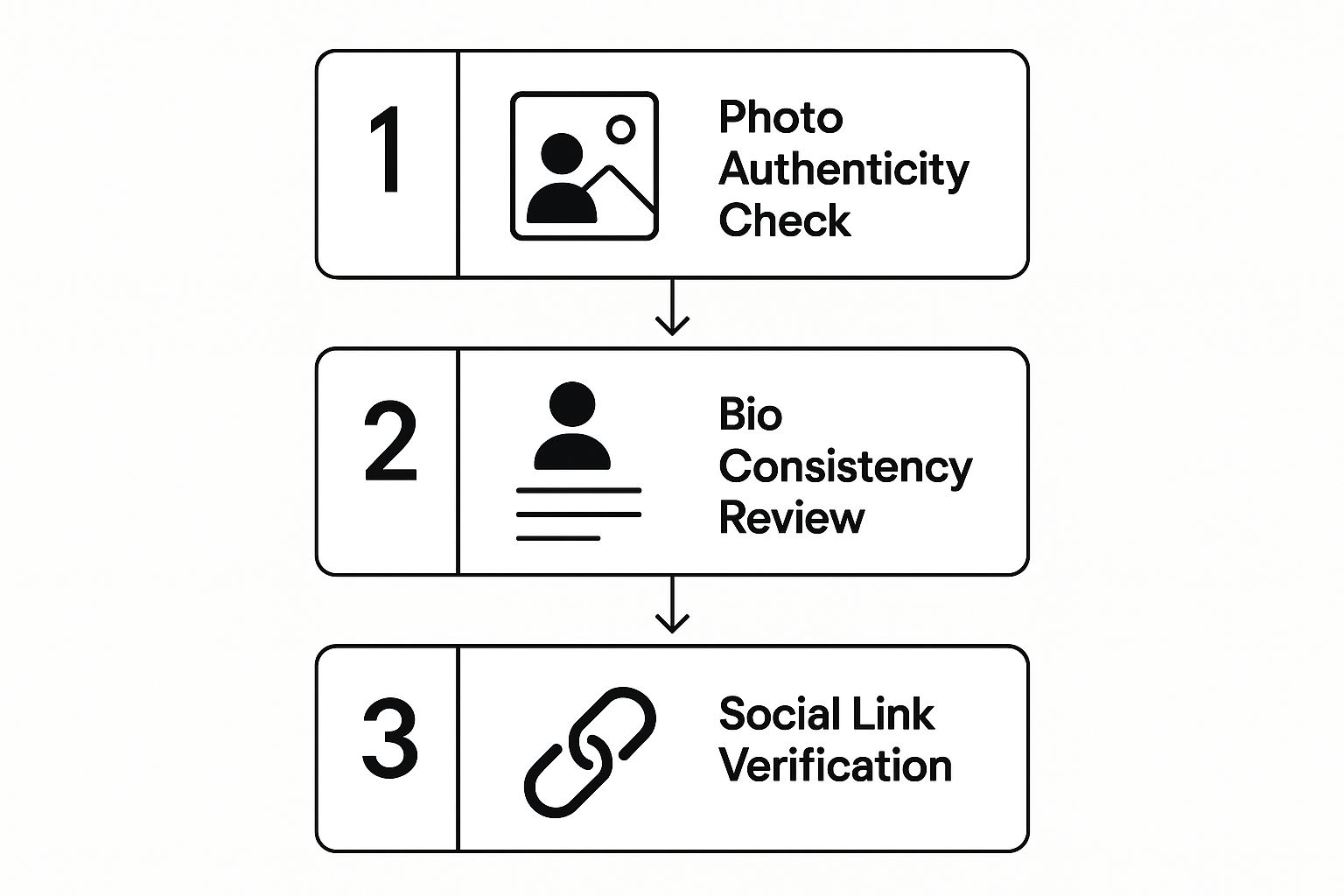
As you can see, checking the photos is a crucial first move, but it's part of a bigger picture that includes looking for consistency across their bio and any other connected accounts.
Common Visual Giveaways
Once you've done a reverse image search, it's time to put on your detective hat and look for other tell-tale signs. Scammers rarely have a full library of candid pictures, and this limitation often reveals itself in predictable ways. Keep an eye out for these classic red flags:
- All Professional Shots: Does every photo look like it came from a magazine shoot? Real people have a mix of pictures—messy holiday snaps, blurry photos with friends, and selfies taken in bad lighting. A profile full of nothing but polished headshots is a major giveaway.
- The Lone Photo: A profile with only one picture is a huge red flag. It's easy for a scammer to find and steal one great photo, but finding a whole album of the same person is much more difficult. Be very suspicious.
- Weirdly Inconsistent Quality: Pay attention to how the photos look together. If one is super sharp and high-res, but the next is grainy and pixelated, it strongly suggests the images were cobbled together from different places on the internet.
When you're looking at profile pictures, it's easy to get bogged down in the details. To make it simpler, I've put together a quick checklist to help you systematically analyse what you're seeing.
Red Flag Photo Analysis Checklist
| Red Flag | What It Looks Like | What You Should Do |
|---|---|---|
| Too Perfect | Every photo is a professional, flawless headshot. No candid or casual shots. | Run a reverse image search to see if the photos appear elsewhere online. |
| Only One Photo | The profile contains a single, often very attractive, picture. | Ask them for another photo or to video chat. A scammer will usually have an excuse. |
| Mismatched Quality | Some photos are crystal clear, while others are blurry, cropped oddly, or pixelated. | This suggests photos were scraped from various online sources. Treat the profile with caution. |
| No Social Context | The person is always alone in their photos. No pictures with friends or family. | Real people usually have photos showing their social life. A lack of this can be a warning sign. |
| Odd Details | Noticeable editing, strange backgrounds, or details that don't match their story (e.g., winter clothes but they claim to live in a hot climate). | Trust your eyes. If something feels off, question it directly or move on. |
Using a simple checklist like this helps you stay objective and spot patterns you might otherwise miss. It turns a gut feeling into actionable evidence.
At the end of the day, trust your instincts. If the photos just feel staged, too polished, or a bit off, it’s worth taking a step back. With some estimates suggesting that up to 10% of all dating profiles are fake, a bit of healthy scepticism is your best friend. When a profile seems too good to be true, it often is.
Reading Between the Lines of Their Bio
A scammer's profile biography is often a house of cards, built with vague clichés and glaring inconsistencies. The photos might look convincing at first glance, but the bio is usually where their story starts to fall apart. Think about it: genuine profiles tend to have a personal, sometimes even quirky, flavour to them.
Fake profiles, on the other hand, often feel bland and generic. They’re designed to cast the widest net possible. You'll see phrases like "loves travelling, movies, and having a laugh." While lots of people enjoy these things, a profile that offers no specifics is a red flag. A real person might mention they’re saving up to see the Northern Lights or that they’re obsessed with 80s horror films. A scammer just keeps it vanilla.
Vague Descriptions and Emotional Hooks
Be on the lookout for bios filled with dramatic life stories that sound a bit too much like a film plot. Scammers love to use emotional hooks, often claiming to be a widowed doctor working abroad or an international entrepreneur facing a sudden, dramatic crisis. These stories are crafted to make you feel instant sympathy, fast-tracking a sense of intimacy that isn't real.
If their life story reads like a soap opera script and their hobbies are as generic as a stock photo, it’s a major warning sign. Real people are much more nuanced and specific.
Poor grammar and spelling can be another dead giveaway, especially if it doesn't match their supposed background. If someone claims to be a "highly educated professor from London" but their profile is riddled with basic mistakes, you should definitely pause for thought. These are the little threads you can pull to unravel the entire fake persona.
Finally, do a quick sense-check. Does their claimed job and location line up with their described lifestyle? If they say they're a struggling artist but their bio talks about frequent luxury trips, something just doesn't add up.
For more insights on building an authentic profile and spotting genuine effort in others, check out our comprehensive dating tips for success.
Spotting the Red Flags in Their Messages
Once you start chatting, a scammer’s true intentions really start to show. The way they message is often the biggest giveaway because it’s all designed to play on your emotions and bypass your common sense. A real connection takes time to grow, but a scammer wants to rush intimacy.
One of their go-to moves is love bombing. This is where they shower you with over-the-top affection and declare their undying love at a speed that feels… well, a bit unsettling. If someone you’ve been talking to for three days is already calling you their soulmate, it’s not romantic—it’s a huge red flag.
If their messages feel like a perfectly polished script, it’s because they probably are. Scammers often rely on pre-written lines meant to pull at your heartstrings, telling you exactly what you want to hear and mirroring your dreams with uncanny precision.
This tactic is disturbingly effective, which is why you need to keep a level head. Recent figures from the Barclays Scams Bulletin revealed that romance fraud in the UK shot up by 20% year-on-year. Even more concerning, 21% of adults on dating apps have been asked for money. You can read the full breakdown on the rise of UK romance scams to see just how widespread this issue has become.
The Classic Excuses and Inevitable Demands
A massive warning sign I see all the time is a complete refusal to meet up or even jump on a quick video call. Scammers always have a ready-made excuse.
- "My camera is broken." Honestly, this is the oldest trick in the book. It’s 2024; almost everyone has a functioning camera in their pocket.
- "I'm working on an oil rig / serving overseas." By creating a situation where meeting is physically impossible, they can keep the con going for months.
- "Let's chat on WhatsApp instead." This is a big one. They want to get you off the dating app’s secure platform as fast as possible, moving the conversation somewhere their account can’t be easily flagged or reported.
And then comes the final, undeniable proof you’re talking to a scammer: the request for money. The story will be heart-wrenching and urgent—a sudden medical bill, a lost wallet while travelling, or a business investment that’s about to fall through. No matter how genuine it sounds, you must never send money to someone you only know from online.
Knowing how to write a good opening message is great, but knowing when to walk away is far more important. If you want to polish your own approach (the genuine kind!), you can take a look at our guide on how to impress with a first message on a dating app.
How to Discreetly Verify Their Identity

A bit of simple verification now can save you a world of heartache later. After you've scrutinised their photos and bio, it’s time to see if their story holds up across the web. This isn't about playing detective; it's about being savvy and using simple checks to confirm they are who they say they are.
A quick, non-intrusive search is the perfect place to start. Just use their name and any other breadcrumbs they’ve dropped—like their job title or city—and see what pops up on other social or professional sites.
Building a Consistent Picture
Searching for them on platforms like LinkedIn or even Instagram can tell you a lot. What you're looking for aren't exact one-to-one matches, but the hallmarks of a real, lived-in digital life. Is there a LinkedIn profile that backs up their claimed profession and career path? Does their Instagram have photos with friends and family that stretch back a few years?
Keep an eye out for these tell-tale signs of an authentic digital footprint:
- Consistency Across Platforms: The details on their LinkedIn should roughly match what they've told you and what’s on their dating profile.
- Signs of Genuine Activity: A real social media account will often have tagged photos, comments from friends, and a posting history that spans years, not weeks. A brand-new account with a handful of posts is a major red flag.
- Mutual Connections: On some networks, you might even find you have friends in common—a massive green flag for legitimacy.
Here's something to keep in mind: a complete absence of a digital footprint can be just as suspicious as conflicting information. In this day and age, very few people have zero online presence. It could mean they’re hiding something, or that the person you're talking to is a complete fabrication.
This kind of basic online vetting helps you piece together a more complete, trustworthy picture of the person on the other end. It’s a straightforward but incredibly effective way to spot a fake profile before you get too invested.
What to Do When You Suspect a Fake Profile
That sinking feeling when you realise the person you're talking to might not be real is deeply unsettling. But don't panic. The most important thing is to act decisively to protect yourself and stop them from preying on anyone else.
Your best friends in this situation are the block and report functions. Every decent dating app has them, and you shouldn't think twice about using them. Reporting flags the profile for the app's safety team to investigate and, hopefully, remove. Blocking cuts off all contact immediately, giving you instant peace of mind. It’s a clean break.
Taking Decisive Action
This is why it pays to choose dating apps with robust safety features right from the start. Things like photo verification, often shown as a blue tick or badge, mean the platform has at least tried to confirm the user is who they say they are. It’s not foolproof, but it’s a simple hurdle that makes life much harder for a scammer.
Trust your gut. It's your most reliable tool in online dating. If something feels off, it probably is. Don't get drawn into a game of trying to expose them—just report, block, and move on. Your emotional energy is as valuable as your personal data.
Learning to handle these situations is, unfortunately, part of the modern dating experience. For more guidance on building safer and more genuine interactions, check out our guide on relationship advice for stronger connections.
If You've Already Sent Money or Information
If things have gone further and you've shared sensitive details or, worse, sent money, you need to act fast. It's easy to feel embarrassed, but please don't. These scammers are masters of manipulation, and their tactics can fool even the savviest people.
Here’s what you need to do, right now:
Contact your bank or credit card company immediately. Tell them you've been a victim of fraud. They can take steps to stop any further payments and will advise you on the chances of recovering your money. The quicker you act, the better.
Report the crime to Action Fraud. This is essential. Action Fraud is the UK’s national centre for reporting fraud and cybercrime. Filing a report creates an official record and helps the authorities build a case against these criminals.
The scale of this problem is staggering. Between early 2020 and late 2024, UK authorities dealt with almost 40,000 reported cases of dating fraud, with victims losing a colossal £409.7 million. You can learn more about the latest UK dating scam statistics to understand just how widespread this is. Your report is a crucial step in fighting back.
At DatingBlog.co.uk, our mission is to help you navigate modern romance safely and with confidence. You'll find more expert advice, in-depth app reviews, and insights across our site. Start your journey to better connections at https://datingblog.co.uk.
Dating News
7 Fun 1st Date Ideas to Try in the UK (2025)
Tired of the usual? Discover our curated list of fun 1st date ideas to make a lasting impression. Find unique and creative options to suit any budget in the UK.

Stepping into the dating world can feel like navigating a maze of clichés. The predictable 'let's grab a drink' suggestion, while safe, often misses the opportunity to create a truly memorable connection. A first date is your initial canvas; it's a chance to paint a picture of who you are and genuinely discover the person sitting opposite you. This is why exploring more engaging and fun 1st date ideas is not just about being different, it's about creating a shared experience that sparks real conversation.
A well-chosen activity reveals personality in ways a simple chat over a pint might not. Whether you're swiping on apps or meeting someone through friends, the right setting can break the ice effortlessly and set the stage for something meaningful. This guide is organised to move beyond the ordinary, offering a curated list of seven dynamic, practical, and enjoyable ideas tailored for the modern UK dater. We'll explore options for every budget, interest, and season, providing the actionable insights you need to plan a first encounter that feels authentic and exciting. Forget awkward silences and think shared laughter, friendly competition, and genuine moments of discovery.
1. The Upgraded Classic: A Specialty Coffee Shop Date
Meeting for a coffee is a timeless first date for good reason. It’s a low-pressure, low-commitment way to test the waters and see if there’s a spark. However, you can elevate this simple meet-up from a mundane interview into a memorable experience by choosing the right venue. Instead of a generic chain, opt for an independent roastery or a café with a distinct personality. This simple choice demonstrates thoughtfulness and a bit of local savvy, setting a positive tone right from the start.

The goal is to find a place that offers more than just caffeine; it should be a conversation starter in itself. A unique setting provides an immediate topic of discussion, helping you bypass the initial awkwardness. Whether it's the quirky decor, the intricate brewing methods, or a unique theme, the environment itself can help fuel natural, flowing conversation. This makes it one of the most reliable and fun 1st date ideas for getting a genuine feel for someone’s personality.
How to Make It a Success
To ensure your coffee date is a hit, a little preparation goes a long way.
- Location is Key: Choose a spot that is convenient for both of you. A café with comfortable seating and a moderate noise level is crucial for easy conversation. Consider places like a cosy café-bookstore where you can browse shelves, or an artisan bakery known for its incredible pastries.
- Do Your Homework: Take five minutes to research the café online. Check their menu for interesting drinks or snacks you can recommend. Knowing they have a signature lavender latte or award-winning cinnamon buns shows initiative.
- Logistical Grace: Arrive a few minutes early to grab a good table, preferably one that isn’t too close to the door or the noisy counter. Be prepared to pay for both drinks; it’s a small, courteous gesture that is always appreciated, regardless of who initiated the date.
2. Art Gallery or Museum Visit
For a first date that feels sophisticated and sparks intellectual curiosity, a visit to an art gallery or museum is an excellent choice. This idea moves beyond the standard interview format of a coffee date, providing built-in talking points that can reveal a person’s creativity, sense of humour, and perspective on the world. It’s an interactive experience that encourages movement and shared discovery, which helps to ease first-date jitters and create a sense of partnership.

Exploring exhibits together allows conversation to flow naturally from your surroundings. You can discuss which pieces you love, which ones you find bizarre, and what emotions they evoke. This shared activity is one of the most fun 1st date ideas because it helps you learn about each other’s tastes and interests in a dynamic and low-pressure environment. Whether you're analysing a classic painting or experimenting with a hands-on science exhibit, you're creating a shared memory from the outset.
How to Make It a Success
A little planning can turn a simple museum trip into a truly impressive date.
- Choose the Right Exhibition: Pick a gallery or museum that aligns with a potential shared interest, or choose one with a diverse collection. A museum with a special, temporary exhibition adds a sense of timeliness. Consider a local history museum, a contemporary photography gallery, or even a science museum with interactive displays.
- Check the Logistics: Research opening times and admission fees beforehand. Many museums have free admission days or late-night openings with a more social atmosphere, which can be a perfect date-night setting. Allow at least two hours for the visit so you don't feel rushed.
- Plan a Follow-Up: Having a plan to grab a coffee, drink, or light meal at a nearby café afterwards is a great move. It provides a relaxed setting to discuss your favourite pieces and continue the conversation. This thoughtful touch can make the entire experience feel more complete and considered, as detailed in these proven first date ideas for a successful romantic experience.
3. Farmers Market or Food Festival
For a date that’s vibrant, interactive, and full of flavour, a trip to a local farmers market or a bustling food festival is an unbeatable choice. This idea moves away from a static, face-to-face setup and into a dynamic environment. Strolling through colourful stalls of fresh produce, artisan cheeses, and sizzling street food provides endless natural conversation starters, making it one of the most engaging and fun 1st date ideas for discovering shared tastes.

The sensory-rich atmosphere allows you to learn about each other in an organic way. You’ll quickly discover their feelings on everything from spicy food to sweet treats, all while enjoying a light physical activity. It’s a low-pressure setting where you can move at your own pace, sampling goods and supporting local vendors. This shared experience feels less like an interview and more like a small adventure, creating a positive and memorable foundation.
How to Make It a Success
A little planning can transform a simple market visit into a fantastic date.
- Pick the Right Venue: Not all markets are created equal. Look for one with a good mix of food stalls, produce, and perhaps even live music to enhance the atmosphere. A seasonal harvest festival, a weekly city market, or a specific food truck event all offer unique vibes.
- Logistical Prep: Arrive early to avoid the biggest crowds and get the best selection. Many vendors still prefer cash, so bring some with you just in case. Also, dressing comfortably is a must; you’ll be on your feet, so practical footwear is key.
- Embrace Sharing: The best part of a food-focused date is trying things together. Suggest sharing a few small items, like a gourmet sausage roll or a box of fresh berries. This creates natural moments of connection and collaboration, helping you bond over a shared culinary experience.
4. Mini Golf or Bowling
Engaging in a light-hearted activity is a fantastic way to break the ice and inject some playful energy into a first meeting. Mini golf or bowling are classic choices because they shift the focus from intense, face-to-face conversation to a shared, interactive experience. This creates natural lulls and highs, allowing conversation to flow more organically around the activity, which is perfect for easing first-date jitters. It’s a chance to laugh at a missed putt or a gutter ball, revealing a lot about someone's sense of humour and how they handle a little friendly competition.

Choosing an activity-based date like this signals that you’re up for a bit of fun and not just a formal interview. The shared goal, whether it’s conquering a windmill obstacle or trying for a strike, builds instant camaraderie. These types of fun 1st date ideas are less about showcasing athletic skill and more about creating shared memories and observing how you interact together in a low-stakes, entertaining environment.
How to Make It a Success
A successful activity date is all about the atmosphere and attitude.
- Pick the Right Venue: Ambiance is crucial. Look for a quirky, themed mini-golf course with creative obstacles or a retro bowling alley with a cool, vintage vibe. Some venues even offer glow-in-the-dark or cosmic bowling sessions, adding another layer of novelty to the experience.
- Keep it Playful, Not Competitive: The goal is connection, not victory. Keep the mood light and focus on having fun together. Offer encouragement, celebrate good shots (both yours and theirs), and laugh off the bad ones. Your reaction to a silly mistake says more than a perfect score ever could.
- Plan a Post-Game Chat: The activity is a great icebreaker, but you still need time to talk. Choose a venue that has an attached bar, café, or arcade. This makes it easy to grab a drink or a snack afterwards to discuss the game and get to know each other better without the pressure of the activity itself.
5. Cooking Class or Food Workshop
Diving into a cooking class or food workshop is a fantastic way to bypass traditional first date nerves. Instead of facing each other across a table, you’re working side-by-side, creating something delicious together. This shared activity fosters collaboration and reveals a lot about a person’s ability to work as a team, their patience, and how they handle a little culinary chaos. It’s an engaging, hands-on experience that ends with a rewarding meal you both helped prepare.
This date idea is perfect because it combines learning a new skill with genuine interaction. The structure of the class provides natural conversation prompts, eliminating the pressure to constantly think of what to say next. Whether you're mastering the art of pasta-making, rolling sushi, or decorating cupcakes, you’re building a shared memory right from the start. This makes it one of the most interactive and fun 1st date ideas for creating an immediate bond.
How to Make It a Success
A successful culinary date hinges on choosing the right class and having the right mindset.
- Choose Wisely: Pick a cuisine or skill you both find exciting. Italian, Thai, or even a baking workshop are usually safe bets. Check local culinary schools, community centres, or even restaurants that host special classes. Ensure the class length fits a first date, aiming for around two to three hours.
- Book in Advance: Popular classes fill up quickly, so book your spot well ahead of time. This shows great planning and ensures you won’t face a last-minute disappointment. Arrive with an appetite, as you’ll almost always get to enjoy the fruits of your labour at the end.
- Embrace the Experience: Don’t worry about being a master chef. The goal is to have fun, not to achieve culinary perfection. Be prepared to laugh at mistakes, help each other out, and enjoy the process. Wear comfortable clothes and closed-toe shoes suitable for a kitchen environment. While a gift isn't expected on a first date, you might find some inspiration for the future; you can discover some thoughtful gift ideas on datingblog.co.uk if things go well.
6. Outdoor Adventure (Hiking, Park Walk, Beach)
Swapping the confines of a café or bar for the great outdoors can be a refreshing and dynamic way to get to know someone. An outdoor date, whether it’s a scenic hike, a relaxed park walk, or a stroll along the beach, removes the pressure of constant eye contact and allows for more natural, side-by-side conversation. This setting provides a shared experience and beautiful scenery, offering plenty of organic talking points to keep the dialogue flowing.
The beauty of this date is its simplicity and flexibility. It taps into a sense of shared discovery, creating a memorable "we did this together" moment right from the start. Plus, the light physical activity can release endorphins, helping both of you feel more relaxed and positive. Choosing an outdoor activity is one of the most enjoyable and fun 1st date ideas for active people or anyone looking to break away from the conventional sit-down meet-up.
How to Make It a Success
A successful outdoor date is all about thoughtful planning and clear communication.
- Choose the Right Location: Select a route or location that matches both of your fitness levels. A sprawling urban park like London’s Richmond Park, a gentle coastal path, or a well-marked nature trail are excellent choices. Ensure it's a popular and safe public area.
- Communicate Clearly: Be upfront about the plan. Let your date know what to expect regarding the terrain and duration, so they can dress appropriately in comfortable shoes and weather-suitable clothing. This shows consideration for their comfort.
- Come Prepared: Check the weather forecast beforehand and have a backup plan (like a nearby pub or café) if it turns. Bring essentials like water, a couple of light snacks, and make sure your phone is fully charged. Planning ahead for parking or public transport saves a lot of stress.
7. Local Event or Festival
Diving into a local festival or community event is a fantastic way to break free from traditional date formats. Instead of a one-on-one interview, you share an experience, creating instant common ground and a dynamic environment filled with energy and things to talk about. This option shows you're engaged with your community and open to vibrant, spontaneous fun.
The beauty of a festival date lies in its built-in entertainment and relaxed atmosphere. Whether it’s an outdoor movie screening, a local music festival, or a cultural food fair, the event itself provides a constant source of amusement and conversation. This shared activity helps ease any initial pressure, allowing you to observe how your date interacts with the world around them while building a stronger connection. This approach makes it one of the more memorable and fun 1st date ideas for creating a shared story from the very beginning.
How to Make It a Success
A little planning can turn a good event date into a great one.
- Do Your Research: Look up local event listings online, on community notice boards, or on social media. Choose an event that aligns with both your interests, whether it's an art and craft fair, a community theatre production, or a seasonal celebration.
- Plan the Logistics: Check the event’s duration, location, and parking situation. Arriving a bit early helps you settle in without rushing. Bring some cash, as smaller vendors at festivals often don't accept cards.
- Be Flexible: The best part of a festival is the potential for spontaneity. While it’s good to have a rough plan, be open to exploring different stalls, trying unusual foods, or listening to a band you’ve never heard of. This adaptability is a key part of the fun.
7 Fun 1st Date Ideas Comparison
| Date Idea | Implementation Complexity 🔄 | Resource Requirements ⚡ | Expected Outcomes 📊 | Ideal Use Cases 💡 | Key Advantages ⭐ |
|---|---|---|---|---|---|
| Coffee Shop Date | Low – simple to arrange | Low – minimal cost | Comfortable conversation, safety | Low-pressure, first meetings | Affordable, flexible, public safety |
| Art Gallery or Museum Visit | Medium – requires planning/time | Low to medium – admission fees | Cultural bonding, meaningful conversation | Those interested in culture and art | Built-in conversation topics |
| Farmers Market or Food Festival | Medium – timing/location dependent | Low – mostly free entry | Shared sensory experiences, food discovery | Food lovers, community event enthusiasts | Multi-sensory, supports local vendors |
| Mini Golf or Bowling | Low to medium – booking recommended | Low – affordable entertainment | Fun competition, breaks conversation tension | Active, playful dates | Light physical activity, humor |
| Cooking Class or Food Workshop | High – advance booking needed | Medium to high – cost of class | Collaboration, tangible results, skill learning | Hands-on, culinary enthusiasts | Teamwork, memorable experience |
| Outdoor Adventure (Hiking, Park Walk, Beach) | Medium – depends on location/fitness | Low – free or low cost | Physical activity, meaningful conversation | Active, nature-loving individuals | Promotes well-being, natural setting |
| Local Event or Festival | Medium – depends on event timing | Low – often free or low cost | Shared cultural experience, entertainment | Social, culturally interested couples | Unique experiences, community support |
Crafting Your Perfect First Encounter
Navigating the world of dating can feel like a complex puzzle, but choosing the right first date shouldn't be the hardest part. As we've explored, the most successful and fun 1st date ideas are not necessarily the most extravagant or expensive. Instead, they are the ones that create a comfortable environment for genuine connection, shared laughter, and authentic conversation.
The central theme weaving through every suggestion, from the creative energy of an art gallery to the collaborative spirit of a cooking class, is the importance of a shared experience. A great first date moves beyond a simple question-and-answer session. It becomes a small story you create together, whether it’s navigating a bustling farmers' market or cheering each other on at the bowling alley. These activities provide natural conversation starters and help you see a different, more relaxed side of your date’s personality.
Key Takeaways for Your Next Date
To truly make your next first date a success, keep these core principles in mind:
- Authenticity Over Spectacle: Choose an activity that reflects your own interests and personality. If you're not an outdoorsy person, a strenuous hike might not be the best representation of who you are. Honesty in your choice of venue sets a precedent for an honest connection.
- Balance Conversation and Activity: The ideal date has a perfect mix of doing and talking. Activities like mini-golf or a walk in the park allow for lulls in the action, providing organic moments for conversation to flow without the pressure of constant eye contact.
- Prioritise Comfort and Safety: The best fun 1st date ideas are those where both people feel completely at ease. This means choosing a public place, considering your date’s comfort levels, and keeping the initial commitment low-pressure. A coffee date is brilliant because it can be extended to a walk or end gracefully after an hour.
Ultimately, the goal of a first date isn't to secure a second one; it's to enjoy a moment in time with another person and see if your energies align. By shifting the focus from "performance" to "presence," you remove immense pressure from yourself and your date. You create a space where you can both be yourselves, which is the only foundation upon which a real relationship can be built. So, take these ideas as a blueprint, personalise them to fit your style, and step into your next first date with confidence and an open mind. The adventure is just beginning.
Ready for more expert advice on navigating the modern dating landscape? For deeper insights, relationship tips, and even more fun 1st date ideas, visit DatingBlog.co.uk. Let us be your trusted companion on your journey to finding a meaningful connection.
Dating News
8 Essential First Date Topics to Spark a Genuine Connection
Struggling with first date topics? Explore our list of 8 engaging conversation starters to move beyond small talk and build a real connection. Read now!
The first date is a delicate balance of excitement and nerves. The pressure to make a good impression can often lead to stilted conversations or falling back on tired clichés. But what if you could bypass the awkward small talk and dive into discussions that genuinely reveal personality, build rapport, and set the stage for a real connection? This guide is designed to do just that, offering a curated selection of engaging first date topics that move beyond the surface.
Forget generic advice; these are strategic prompts to help you understand your date's values, passions, and worldview. At DatingBlog.co.uk, we specialise in providing modern singles with the tools for meaningful romance, and a great conversation is the first step. We’ve organised each topic with specific questions and practical tips to ensure the dialogue flows naturally, helping you learn about everything from their travel dreams and hobbies to their career journey and life goals. By the end of this article, you will have a comprehensive toolkit to transform any first meeting from an interview into an engaging, memorable experience. This isn't just about avoiding awkward silences; it's about building a foundation for something more.
1. Travel Experiences and Dreams
Discussing travel is one of the most reliable and revealing first date topics. It opens a window into your date's personality, values, and zest for life. Whether recounting past adventures or sharing future aspirations, this conversation allows you to discover common interests and gauge each other's sense of curiosity and openness to new experiences.

It’s a topic that naturally encourages storytelling, moving beyond simple Q&A and into a more dynamic and engaging exchange. You can learn whether they are a meticulous planner or a spontaneous adventurer, a luxury seeker or a budget backpacker. This isn't just about listing destinations; it’s about sharing the feelings and memories attached to them.
Why This Topic Works So Well
Talking about travel is universally appealing and less intrusive than other personal topics. It provides a positive and aspirational framework for conversation, keeping the mood light while still offering depth. It is an excellent way to see how your worldviews might align.
Key Insight: Focus on the why behind their travel choices. Asking what drew them to a specific place or what they learned from an experience offers much deeper insight than simply asking where they have been.
How to Approach the Conversation
Keep the discussion inclusive and avoid making anyone feel inexperienced. If your date hasn't travelled internationally, pivot to local explorations or dream destinations.
- Start Broad: Begin with an open-ended question like, "Have you done any travelling you've particularly enjoyed?" or "If you could hop on a plane tomorrow, where would you go?"
- Share Your Own Stories: Offer a brief, interesting story of your own. Mentioning a funny travel mishap can be very endearing and shows you don’t take yourself too seriously.
- Ask Follow-Up Questions: Go beyond the surface. Instead of just "Did you like it?" ask, "What was the most surprising thing you discovered there?" or "What's your favourite memory from that trip?"
This approach ensures the conversation remains balanced and becomes a shared exploration rather than an interview, making it one of the most effective first date topics for building a genuine connection.
2. Hobbies and Passions
Delving into hobbies and passions is a fantastic way to understand what truly makes your date tick. This topic uncovers what energises them, how they spend their free time, and what they value outside of work. It’s a direct look into their personality, revealing whether they are creative, analytical, adventurous, or community-oriented.

Talking about what you love doing naturally brings out enthusiasm and positive energy, making the conversation more animated and genuine. Whether it's a passion for rock climbing that reveals a love for physical challenges, a dedication to cooking that shows a nurturing side, or an interest in photography that highlights a creative eye, these details are invaluable.
Why This Topic Works So Well
Hobbies are a low-pressure, high-reward area of conversation. Unlike work or family history, they are chosen interests, offering a pure reflection of someone's personality. This is one of the most effective first date topics because it opens doors to finding shared interests and planning potential second dates.
Key Insight: The goal isn't just to list activities but to understand the feeling behind them. Ask what they get out of their hobby or what they love most about it to uncover their core motivations and values.
How to Approach the Conversation
Show genuine curiosity and be prepared to share your own passions with equal enthusiasm. The key is to create a balanced exchange, not an interrogation.
- Open with a Casual Question: Start with something relaxed like, "What do you love to do when you're not working?" or "Have you picked up any interesting hobbies lately?"
- Share Your Own Passions: Talk about one of your interests and what it means to you. For example, "I've recently gotten into watercolour painting; I find it so relaxing." This invites them to share in return.
- Ask Deeper Follow-Up Questions: Move beyond the surface. Inquire with questions such as, "That sounds fascinating, how did you first get into that?" or "What's the most rewarding part of that for you?"
This approach allows the conversation to flow organically, building a connection based on the things that bring you both joy and fulfilment.
3. Career and Professional Journey
Navigating conversations about work on a first date can be a delicate balance, but when handled correctly, it offers valuable insight into a person's passions, ambitions, and values. Discussing professional journeys isn't about reciting a CV; it's about understanding what drives someone, what challenges they enjoy, and how they see their contribution to the world.

This topic can reveal a lot about a person’s character. For instance, a teacher's story about their passion for education or an entrepreneur's tale of their startup's highs and lows provides a much deeper understanding than their job title alone. It’s an opportunity to connect over shared values like dedication, creativity, or work-life balance.
Why This Topic Works So Well
A person’s career often takes up a significant portion of their life, making it a relevant and substantial area of conversation. It moves beyond superficial chat to explore what a person is truly passionate about and proud of. When approached with curiosity, it becomes one of the more revealing first date topics for gauging long-term compatibility.
Key Insight: The goal is to understand the person, not the position. Focus on their feelings about their work, the "why" behind their career choices, and the stories they tell, rather than getting bogged down in industry jargon or salary talk.
How to Approach the Conversation
The key is to keep the tone light and inquisitive, not like a job interview. Frame your questions around experiences and feelings to ensure the discussion remains personal and engaging rather than purely professional.
- Start Broad: Use open-ended questions like, "What’s the most interesting or surprising thing that’s happened to you at work?" or "What led you down your current career path?"
- Share Your Own Journey: Talk about what you find fulfilling in your own work or mention a project you're excited about. This creates a reciprocal exchange.
- Ask Follow-Up Questions: Dig deeper with genuine curiosity. Ask, "What do you enjoy most about what you do?" or "What's the biggest lesson you've learned in your career so far?"
By focusing on passion and personal growth, you can transform a potentially dry topic into a fascinating window into your date's world, making the conversation both meaningful and memorable.
4. Food and Dining Experiences
Food is a universal language, making it one of the most enjoyable and effortless first date topics. It's a subject everyone can relate to, offering a fun way to explore cultural backgrounds, personal preferences, and lifestyle choices. From favourite childhood meals to ambitious cooking projects, this conversation can reveal a lot about a person’s sense of adventure and comfort.

This topic is more than just listing favourite cuisines; it’s about sharing stories and experiences. Discussing food can organically lead to planning a second date, whether it's trying a recommended restaurant or even cooking together. It uncovers whether your date is an adventurous eater, a home-comforts connoisseur, or a passionate home cook.
Why This Topic Works So Well
Talking about food is inherently positive and low-pressure. It taps into memories, traditions, and simple pleasures, fostering a sense of warmth and connection. It’s a brilliant way to find common ground and learn about each other's daily lives and cultural roots without being too intrusive.
Key Insight: Go beyond likes and dislikes. Asking about a food that evokes a strong memory or a family recipe they cherish can reveal personal stories and emotional connections, making the conversation far more meaningful.
How to Approach the Conversation
Keep the discussion light, positive, and inclusive. Focus on enjoyment and exploration rather than dietary restrictions or criticisms, which can dampen the mood. The goal is to share and connect over a shared human experience.
- Start with Broad Questions: Kick off with something open and inviting, like, "Have you tried any great new restaurants lately?" or "What's the best meal you've had this year?"
- Share Your Own Experiences: Talk about a dish you love to cook or a funny story about a time you tried something exotic. This makes the conversation a two-way street and shows your own personality.
- Ask About Their Background: Inquire gently about food from their childhood or family traditions. Questions like, "Was there a special dish your family always made for celebrations?" can lead to lovely, personal anecdotes.
By exploring this subject, you can not only have an engaging chat but also gather ideas for future romantic experiences, perhaps finding some inspiration from these proven first date ideas for a successful romantic experience in the UK. This makes food one of the most versatile and rewarding first date topics available.
5. Entertainment Preferences
Discussing entertainment preferences like films, TV shows, music, and books is a fantastic way to find common ground and understand your date's cultural tastes. This topic is light, fun, and offers countless avenues for conversation, revealing personality traits and shared interests without feeling too intrusive. It helps you see if your pop culture worlds align, which can be a strong indicator of compatibility.
From bonding over a mutual love for a niche sci-fi series to discovering you both frequent the same local music venues, these shared passions create an immediate connection. Learning about their entertainment choices provides a snapshot of how they unwind, what makes them laugh, and what stories resonate with them. It’s a comfortable yet insightful way to explore each other's inner worlds.
Why This Topic Works So Well
Entertainment is a universally relatable subject that keeps the atmosphere relaxed and enjoyable. It acts as a low-stakes entry point into more personal values and perspectives. Sharing what you watch, read, or listen to is an excellent way to gauge compatibility in lifestyle and leisure activities, making it one of the most reliable first date topics.
Key Insight: Go beyond just listing favourites. Ask why they love a particular film or what they get from a certain type of music. Understanding their emotional connection to entertainment reveals much more about their personality than the titles themselves.
How to Approach the Conversation
The goal is to foster a shared exchange, not to test each other's knowledge. Be open-minded and show genuine curiosity about their tastes, even if they differ from your own.
- Start with Recent Enjoyment: Ask, "Have you seen or read anything brilliant lately?" This is less pressure than asking for an all-time favourite.
- Find Common Ground: If you discover a shared love for a TV show, dig deeper. "Who's your favourite character? What did you think of the last season's finale?"
- Share and Recommend: Offer a recommendation of your own. Saying, "If you liked that, you might love this book I just finished," shows you're engaged and opens the door for future conversations.
This approach turns a simple chat about entertainment into a dynamic exploration of shared interests, building a foundation for a genuine connection. It’s an easy-going topic that can quickly highlight your compatibility.
6. Family and Background
Carefully discussing family and background can be one of the most rewarding first date topics, offering a glimpse into what has shaped a person. It reveals their values, traditions, and the important relationships that have influenced them. Approached with sensitivity, this conversation can build a foundation of genuine understanding and emotional connection.
This topic moves beyond surface-level chatter to explore the roots of someone's personality. Sharing positive childhood memories, funny family anecdotes, or meaningful traditions helps to humanise both of you. It's an opportunity to discover their cultural heritage, what they learned growing up, and how they relate to the people closest to them.
Why This Topic Works So Well
Understanding someone's family dynamics and upbringing provides context for who they are today. It's a topic that, when handled correctly, signals a deeper interest in them as a person, not just a potential partner. It can uncover shared values and life lessons, creating a powerful sense of connection and seeing if your core principles align.
Key Insight: The goal is not to interrogate, but to share. Frame the conversation around positive experiences and general values. Asking about a favourite family tradition or a funny story about a sibling is much more effective than asking direct, potentially sensitive questions.
How to Approach the Conversation
Navigating this topic requires tact and emotional intelligence. Always start light and be prepared to change the subject if your date seems uncomfortable. The key is to keep it positive and focused on broad themes rather than intimate details.
- Start Broad: Use open-ended questions like, “Are you close with your family?” or “Do you have any fun family traditions?”
- Share Your Own Stories: Lead by example. Share a brief, heartwarming, or amusing story about your own family. This makes it a reciprocal exchange and builds trust.
- Ask Follow-Up Questions: If they mention a sibling, you could ask, "What were you two like as kids?" If they talk about a tradition, ask, "Is that something you'd want to carry on?" Acknowledging if they have children and showing interest is also important; dating someone with kids has its own unique dynamics that are valuable to understand.
By keeping the tone light and respectful, you can make this one of the most connecting first date topics, showing that you’re interested in understanding them on a much deeper level.
7. Life Goals and Aspirations
Discussing life goals and aspirations is one of the most powerful first date topics for understanding long-term compatibility. This conversation moves beyond the present moment to explore future dreams, revealing a person’s core values, drive, and what truly motivates them. It offers a glimpse into their life’s direction and whether your paths might one day align.
This topic allows you to see what excites your date about the future. Are they driven by career ambitions, personal growth, creative pursuits, or a desire to make a difference in the world? Sharing these vulnerabilities can create a surprisingly deep connection early on, building a foundation based on mutual respect for each other’s ambitions.
Why This Topic Works So Well
Talking about aspirations is inherently positive and forward-looking. It lifts the conversation into an inspiring space, showing you both as individuals with purpose and passion. It’s a fantastic way to gauge ambition and priorities without being overly serious or intrusive, helping you understand what kind of life they envision for themselves.
Key Insight: The goal isn't to judge their ambitions but to understand their passion. Listen for the excitement in their voice when they talk about their dreams, whether it’s starting a business, writing a novel, or mastering a new skill.
How to Approach the Conversation
This topic requires a little finesse to avoid sounding like a job interview. Frame it with curiosity and positivity, making it clear you are interested in their passions, not just their five-year plan.
- Ease Into It: Start with a gentle prompt like, "Is there anything you're really passionate about working towards right now?" or "What's a big dream you have for the next few years?"
- Share Your Own Dreams: Be willing to open up first. Sharing one of your own aspirations, big or small, shows vulnerability and encourages them to do the same.
- Focus on Growth: Ask questions that centre on personal fulfilment. For instance, "What skill would you love to learn if you had all the time in the world?" or "Is there a creative project you dream of starting?"
- Explore More Tips: For a broader overview of how to build rapport, you can explore more detailed dating tips for success on datingblog.co.uk.
This approach ensures the discussion remains an exciting exchange of dreams, not a formal evaluation, making it a brilliant method for assessing compatibility while keeping the date’s atmosphere uplifting.
8. Childhood and Formative Experiences
Sharing stories from your childhood offers a unique way to build emotional connection and understand how your date became the person they are today. This topic delves into formative experiences and nostalgic memories, revealing core values and personality traits in a fun, often light-hearted manner. It moves the conversation beyond surface-level facts into the realm of personal history and character formation.
Discussing growing-up stories, from funny mishaps to favourite games, provides a rich source of shared humanity and humour. You can learn about their family dynamics, where they grew up, and what shaped their early interests. It's a fantastic way to find common ground and create a sense of familiarity and warmth.
Why This Topic Works So Well
Childhood is a universal experience, making it a relatable and accessible topic. It allows for vulnerability and authenticity without venturing into overly intense territory. These conversations foster nostalgia and positive feelings, making it one of the most effective first date topics for creating a deeper, more personal bond.
Key Insight: The goal isn't to psychoanalyse your date's upbringing. Instead, focus on how their favourite childhood memories or activities have shaped the person they are now, revealing passions and personality traits that persist today.
How to Approach the Conversation
Navigate this topic with care, keeping the tone positive and steering clear of potentially painful memories. The aim is connection, not a therapy session.
- Start Light: Begin with a fun, open question like, "What was your favourite thing to do as a kid?" or "Were you a well-behaved child or a bit of a troublemaker?"
- Share a Funny Story: Lead by example with a short, amusing anecdote from your own childhood. A story about an embarrassing school play or a silly belief you held can be incredibly endearing.
- Ask About Influences: Inquire about positive figures or experiences. "Was there a teacher who really inspired you?" or "What's the best piece of advice your grandparents ever gave you?"
By keeping the focus on positive, funny, and formative moments, you can explore each other's backgrounds in a way that feels safe, engaging, and genuinely revealing.
First Date Topic Comparison Matrix
| Topic | Implementation Complexity 🔄 | Resource Requirements ⚡ | Expected Outcomes 📊 | Ideal Use Cases 💡 | Key Advantages ⭐ |
|---|---|---|---|---|---|
| Travel Experiences and Dreams | Low – casual storytelling | Low – personal stories | Reveals personality, worldview, shared interests | Icebreakers, revealing personality and values | Safe, relatable, opens multiple sub-conversations |
| Hobbies and Passions | Low – enthusiastic sharing | Low-medium – some activity details | Shows personality, priorities, potential shared activities | Building rapport via common interests | Encourages authentic expression and enthusiasm |
| Career and Professional Journey | Medium – more formal, boundary sensitive | Medium – requires thoughtful questions | Insight into ambition, goals, work-life balance | Assessing compatibility on life direction | Reveals responsibility, achievements, stability |
| Food and Dining Experiences | Low – light, engaging | Low – universally relatable | Reveals cultural background, lifestyle preferences | Easygoing, fun conversation starter | Creates immediate date ideas and cultural insight |
| Entertainment Preferences | Low – casual and relaxed | Low – common interests | Shows tastes, personality, cultural interests | Light first dates, discovering shared hobbies | Easy flow, broad topic with many follow-ups |
| Family and Background | Medium-High – sensitive and personal | Medium – requires emotional awareness | Reveals core values, relationship patterns | Deeper connection, bigger emotional insights | Builds emotional understanding and trust |
| Life Goals and Aspirations | Medium – potentially serious | Low-medium – requires thoughtful dialogue | Reveals long-term compatibility, motivation | Assessing future alignment and values | Inspiring, forward-looking conversation |
| Childhood and Formative Experiences | Medium – personal and nostalgic | Medium – needs sensitivity | Shows personality development, emotional connection | Building vulnerability and authenticity | Fosters bonding and deeper personality insight |
Turning Conversation into Connection
Navigating a first date can feel like walking a tightrope, but armed with the right approach, it becomes an exciting journey of discovery. The first date topics we've explored, from travel dreams to career journeys, are more than just items on a checklist. They are carefully selected keys, each designed to unlock a different door into your date's personality, values, and what truly makes them tick. The goal isn't to mechanically work your way through a list, but to use these prompts as a springboard for genuine, flowing dialogue.
Remember, the quality of a conversation isn't measured in the number of topics covered, but in the depth of the connection forged. The most memorable first dates are rarely about finding someone with identical hobbies or a matching five-year plan. Instead, they are about discovering a shared sense of humour, a mutual curiosity, or an unexpected spark that ignites when you share a vulnerable story or a passionate ambition. The real magic happens in the follow-up questions, the active listening, and the moments you realise you're not just talking, but truly hearing each other.
The Art of the Follow-Up
The true power of any conversation starter lies in what comes next. Simply asking "What are your hobbies?" might get you a one-word answer. But following up with "What was it about that hobby that first drew you in?" or "Is that something you do to relax or to challenge yourself?" transforms a simple question into a meaningful exploration.
Think of it as a dance: you lead with a topic, your date responds, and you react with genuine interest and a thoughtful follow-up. This back-and-forth rhythm is what builds rapport and turns a simple Q&A session into an engaging shared experience.
Beyond the Script: Authenticity is Your Superpower
Ultimately, the most crucial takeaway is to be yourself. This guide is designed to give you confidence and structure, not to provide a script. If a topic feels forced or inauthentic to you, skip it. Your genuine enthusiasm for a subject will always be more engaging than a perfectly phrased but dispassionate question.
The best first date topics are those that allow both of you to shine. By focusing on open-ended questions and demonstrating sincere curiosity, you create an environment where your date feels comfortable and valued. This approach doesn't just lead to better first dates; it lays the groundwork for a potential relationship built on respect, understanding, and authentic connection. It's about moving beyond the surface level to see if your stories, not just your interests, are compatible.
Ready to master every stage of the dating journey? From crafting the perfect profile to navigating the nuances of a new relationship, DatingBlog.co.uk offers expert-backed advice and practical guides. Explore more articles and resources at DatingBlog.co.uk to date with more confidence and success.
 Dating News2 years ago
Relationship Advice for Women and Men: Building Stronger Connections
- Dating News1 year ago
How to Spot Fake Dating Profiles A Modern Guide
- Senior Dating2 years ago
Dating Sites for Over 60s: a Comprehensive Guide to Finding Love in Old Age
- Dating tips2 years ago
Why Some Readers Are Not Interested in Dating Manhwa: Exploring Different Preference
- Dating News and Updates2 years ago
Free Canadian Dating Sites for Over 50
- Dating News1 year ago
8 Dating Profile Examples: Strategic Breakdown (2025)
- Dating News and Updates2 years ago
The best dating sites for older ladies: Find love and companionship at any age
- Dating News1 year ago
12 Best Free Dating Sites UK: Your 2025 Guide to Love